We know that recessions happen, and they seem to be a fairly common phenomenon. To some extent, every recession looks very similar. Overall economic activity and national economic activity decline, unlike a blizzard affecting only a specific region or a boom in a particular industry (like technology). Durable goods, investment, real estate, and things used for financing suffer more, while services and non-durable goods (food) fall much less. Employment declines, and unemployment rises. While most people are hesitant, a minority are quietly laying the groundwork for the next wealth leap.
Recessions often occur when something bad happens—like the financial crises of 1933 and 2008, the sharp tightening of monetary or credit policies and oil market turmoil of 1973 and 1979, and the end of economic boom cycles of 1929 and 1999. But these are usually just amplifying factors, not the complete cause. Because sometimes, these events don't lead to a recession.
So what exactly causes a recession?
The reasons that cause recessions and drive these mechanisms have been highly debated. The simultaneous collapse of many businesses proves that Keynesian "insufficient demand" is wrong. But why do people wake up one day suddenly wanting to reduce consumption? Why is the same thing happening all over the country? The economy is certainly more complex than one-dimensional "stimulus" theory describes.
One cause of economic recessions is the natural fluctuation of some businesses expanding while others contract. The 2008 recession, for example, was partly due to the fact that we weren't all moving to Las Vegas, so there was a need to stop building houses there. The 1999 recession was, in part, because the first wave of internet growth had ended. Now, it seems that this wave of internet growth is also nearing its end. As the big bets on unlimited growth fail, and as people move from one job to another, the economy will at least slow down.
Even the famous recessions of 2008 and 1929 showed clear signs of slowing economic activity before the financial panic. The financial panic was at least partly caused by the slowdown in growth. As we are seeing now in the tech sector, high-risk companies that had bet on years of sustained growth suddenly depreciated. If banks had too much exposure to these businesses, feedback would make things worse.
Seizing Opportunities During Economic Recession
Wealth Transfer Mechanisms During Economic Downturns
Economic downturns appear fraught with crisis on the surface, but in reality, they conceal opportunities. Crises lead to severe undervaluation of asset prices. When everyone is panic selling, the prices of truly valuable assets are far below their intrinsic value.
In this environment, those with cash reserves and the courage to act seize unprecedented opportunities. As Warren Buffett said, "Be fearful when others are greedy, and greedy when others are fearful." However, this "greed" is predicated on having sufficient cash reserves.
Contrarian Thinking: How to Find Opportunities in a Crisis
John Templeton, the father of global investing, famously said, "Bull markets are born of pessimism, grow in skepticism, mature in optimism, and die in euphoria." He pointed out that the best time to buy is when the market is most pessimistic, and the best time to sell is when the market is most optimistic.
Throughout his 70-year career, Templeton consistently adhered to the principle of "buying when the market reaches its most pessimistic point." Between 1937 and 1938, the US stock market plummeted by more than half in 12 months, reaching a point of extreme pessimism.
Entrepreneurship is actually easier during economic downturns.
While the entrepreneurial environment appears difficult during economic recessions, it actually harbors unique advantages.
Competition decreases. During economic booms, the market gradually becomes saturated, with numerous strong players, making it difficult for ordinary people to easily find opportunities. However, during economic recessions, many businesses close down, competitors decrease drastically, and the market begins to reshuffle. Large companies lay off employees, industry giants withdraw, and new market share is left vacant.
Costs decrease significantly. Whether it's rent, labor costs, or raw material prices, they all decrease during economic recessions. This means that with the same amount of capital, more can be accomplished. Many successful entrepreneurs will tell you that what they are most grateful for is starting their businesses during difficult times, because it taught them how to maximize efficiency with limited resources.
Shifting consumer demands create new opportunities. During economic hardship, people pay more attention to the cost-effectiveness of products. This creates opportunities for companies that can provide high-quality products and services at low prices.
Historical Lessons: How Wealth Shifts During Crises
During economic crises, wealth doesn't truly disappear, but rather is reshuffled across different social strata. Understanding this process is crucial for seizing opportunities.
Take the Latin American debt crisis as an example. In the debt crisis of the 1980s, there was a significant transfer of social wealth to the upper-class bourgeoisie. Powerful private groups took advantage of the financial chaos during the crisis to accumulate vast amounts of financial assets.
After the 2008 financial crisis, central banks worldwide launched the policy of "quantitative easing." Between 2008 and 2014, the Federal Reserve easily injected over $3 trillion into the market through three rounds of quantitative easing; however, most of this money flowed into the financial markets rather than the real economy.
The result was that the rich got richer and the poor got poorer. Between 2008 and 2012, the wealth of the richest 1% of Americans increased by 31%, while the wealth of the bottom 90% decreased by 4%.
Practical Strategies for Survival and Development During Crises
In a sluggish economy, practical strategies are needed to stand out. Focus on improving value for money. Consumers become more frugal during economic hardship. Like the breakfast vendor at the market, who accumulated many repeat customers by providing high-quality, reasonably priced products, eventually growing from a stall to a shop.
Maintain existing customer relationships. Acquiring new customers is more expensive during economic downturns, making it especially important to retain existing customers. Maintaining a long-term perspective is crucial. Wealth creation takes time; the true returns on assets purchased or businesses established during a crisis may only become apparent after economic recovery. Many people rush to cash out immediately after a crisis, missing out on the greatest gains.
Controlling risk requires avoiding excessive leverage. Uncertainty intensifies during economic downturns, necessitating more cautious risk management. Simultaneously, avoid excessive debt and ensure sufficient cash flow to cope with potential difficulties.
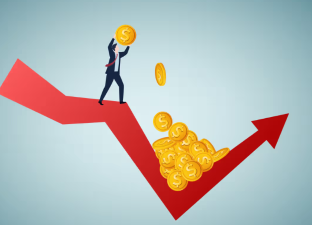
What other misconceptions exist about economic recessions?
People also misunderstand the nature of unemployment. Even during recessions, most people find work relatively quickly. The real issue is the labor force participation rate—the number of people seeking work declines regardless of economic conditions.
An "economic recession" refers to a period of declining income and rising unemployment. However, even after a recession ends, we remain in a challenging period of low income and high unemployment for a considerable time. Therefore, I believe that if we can redefine a recession, it should be based on low GDP and high unemployment, rather than economic growth.
Another mistake most people make is exaggerating the impact of recessions, which, while painful, have a limited overall impact. A severe recession might indeed cause incomes to drop by 5% over several years. But long-term economic growth will dwarf such fluctuations. In 1950, the average annual income was less than $15,000 in 2012 dollar terms, while it is now $60,000. The difference is enormous.
Currently, stagnant economic growth is our bigger problem. Long-term economic growth rates are more important than annual growth rates. Recessions are painful interruptions, but we should focus more on long-term economic growth trends.